
Cervical Mucus and Ovulation: How to Identify Your Fertile Window Naturally
If you're trying to conceive, you've probably wondered: "When am I actually fertile?"
Many women reach for a period-tracking app to figure out when they are most fertile, and while this can sometimes be helpful, apps often rely on predictions based on an "average" menstrual cycle. The problem? Very few women ovulate on the exact day an app predicts every month.
Fortunately, your body gives you some important clues.
One of the most reliable signs that ovulation is approaching is a change in your cervical mucus (also called cervical fluid). By learning to recognize these changes, you can identify your fertile window in real time instead of relying solely on calendar estimates.
Throughout this article, I'll use the terms cervical mucus and cervical fluid interchangeably—they refer to the same substance produced by your cervix that changes throughout your cycle in response to your hormones.
Whether you're hoping to conceive soon or simply want to understand your cycle better, cervical mucus is one of the most valuable fertility signs your body provides.
Key Takeaways
Cervical mucus changes throughout your menstrual cycle in response to estrogen and progesterone.
Egg white cervical mucus usually signals that ovulation is approaching and you're in your fertile window.
Healthy cervical mucus helps sperm survive for up to five days, dramatically increasing the chances of conception.
If you rarely notice fertile-quality cervical mucus, it may be worth evaluating hydration, medications, hormone levels, thyroid function, or your vaginal microbiome.
What Is Cervical Mucus?
Cervical mucus is a fluid produced by glands within the cervix. Although many people don't think much about it, cervical mucus plays an essential role in reproduction. Its consistency, quantity, and function change throughout the month in response to fluctuations in estrogen and progesterone.
Cervical mucus is an incredibly sophisticated biological system designed to either encourage or discourage sperm movement depending on where you are in your cycle.
During your fertile window, cervical mucus becomes thinner and slipperier, creating an ideal environment for sperm to survive and travel toward the egg. After ovulation, progesterone causes cervical mucus to become thick and sticky, forming a barrier that makes it much more difficult for sperm to pass through the cervix.
Your body is constantly adjusting cervical mucus depending on where you’re at in your cycle.
Why Does Cervical Mucus Change Throughout the Menstrual Cycle?
After your menstrual period ends, estrogen gradually rises as follicles develop within your ovaries. As estrogen increases, your cervix produces progressively more cervical mucus.
Immediately after your period, you may notice very little fluid. As estrogen continues to climb, cervical mucus initially becomes creamy or lotion-like. In the days leading up to ovulation, it transforms into the clear, slippery, stretchy consistency commonly known as egg white cervical mucus (EWCM).
Researchers have found that proteins called mucins align themselves differently under the influence of estrogen. These microscopic structural changes create tiny channels within the mucus that guide healthy sperm through the cervix toward the uterus and fallopian tubes, while making it more difficult for sperm with poor motility or abnormal sperm to pass.
At the same time, cervical mucus performs several other important jobs:
Provides nutrients that help nourish sperm
Protects sperm from the naturally acidic environment of the vagina
Creates an environment where sperm can survive for up to five days while waiting for ovulation to occur
Helps prevent bacteria and other pathogens from traveling upward into the uterus
What Does Egg White Cervical Mucus Mean?
When most people talk about fertile cervical mucus, they're referring to egg white cervical mucus (EWCM).
This type of mucus is typically:
Clear or slightly cloudy
Slippery
Stretches between your fingers
Similar in consistency to a raw egg white
Seeing this type of cervical mucus is one of the main indicators that ovulation is approaching.
It is important to note: cervical mucus predicts ovulation—it doesn't confirm that ovulation has already occurred. That's why it's such a valuable fertility sign for couples trying to conceive.
The highest pregnancy rates occur from intercourse in the one to two days before ovulation, when sperm are already waiting in the fallopian tube for the egg to be released. Because healthy sperm can survive in fertile cervical mucus for up to five days, having intercourse during the days leading up to ovulation gives you the greatest opportunity for conception.
If you're trying to conceive, don't wait until after you think you've ovulated. Instead, use fertile cervical mucus as your body's signal that your fertile window has opened.
If you've been trying to conceive or want to optimize your fertility before pregnancy, my Fertility & Preconception care focuses on identifying and addressing the root causes that may be affecting your chances of conception.
How to Check Cervical Mucus
Tracking cervical mucus is free, simple, all-natural, and helps give you a better understanding of your body and your cycle.
External observation
After your period ends, start to check for cervical mucus each time you use the restroom:
Wipe from front to back toward your perineum.
Notice how the tissue feels as you wipe. Does it feel dry or slightly resistant? Or does it glide smoothly because the area feels slippery?
Look at any mucus left on the toilet paper and note its color and consistency.
Internal observation
Some women find it easier to evaluate cervical mucus internally.
After washing your hands thoroughly:
Insert one clean finger into your vagina until you reach near the cervix.
Move your finger around to collect a small amount of mucus.
Roll it between your thumb and index finger.
Slowly separate your fingers to see whether the mucus stretches before breaking—fertile cervical mucus may stretch several inches before it separates.
As you continue tracking over several months, you'll begin to recognize your own unique pattern. While every woman is different, most notice a progression from drier days after menstruation to more profuse, fertile mucus leading up to ovulation, followed by a return to thicker mucus after ovulation occurs.
What If You Don't See Egg White Cervical Mucus?
If you've started paying attention to your cervical mucus and haven't noticed obvious egg white cervical mucus, don't panic.
Some women naturally produce very little mucus externally, even when they're ovulating normally. Others find that most of their cervical mucus stays higher up near the cervix and is easier to observe when checking internally with clean fingers.
Learning to recognize your body's fertility signs also takes practice. It often takes two or three menstrual cycles before patterns become obvious. However, if you consistently notice very little fertile-quality cervical mucus after several cycles, there are several possible reasons which we'll discuss later in this article.
Cervical Mucus Timeline: What to Expect Throughout Your Cycle
Cervical mucus typically follows a predictable pattern throughout the menstrual cycle as your hormones fluctuate. Learning to recognize these changes can help you identify when your fertile window is approaching.
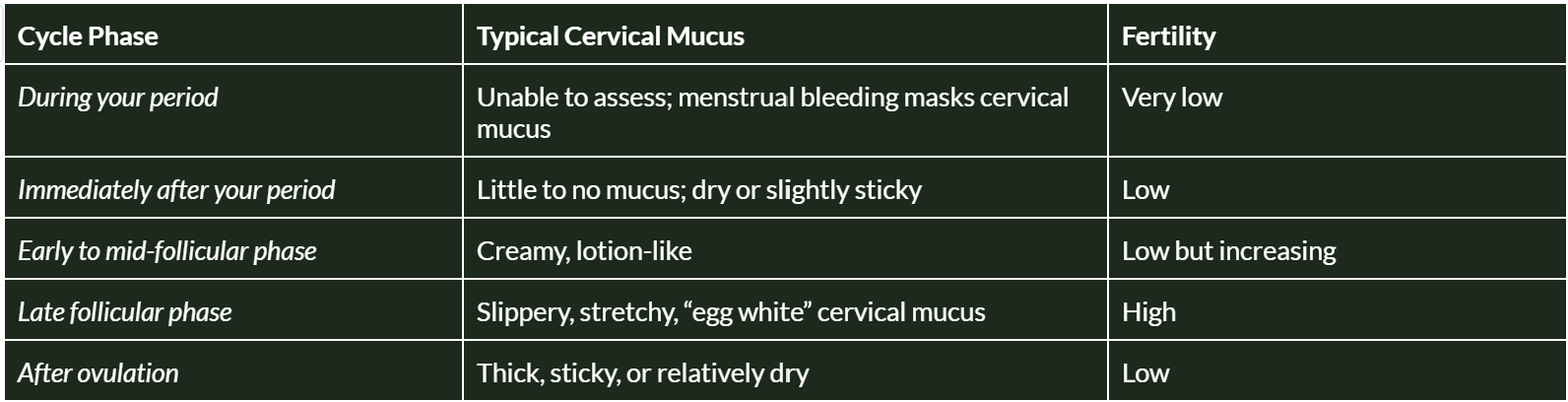
Your peak fertility day is the last day you observe fertile-quality cervical mucus—typically slippery, stretchy, or egg white-like. Ovulation usually occurs within about 24 hours of this day, making it one of the most fertile times in your cycle and the best day to have intercourse if you are TTC. Of course, you will need to track for a few months before you have an idea of when this last day of fertile cervical mucus falls in your cycle.
If you're trying to conceive, aim to have intercourse at least every other day once you begin noticing fertile cervical mucus. As your mucus becomes increasingly slippery and abundant, you may choose to have intercourse daily if that feels manageable and enjoyable. Since sperm can survive for up to five days in fertile cervical mucus, intercourse during the days leading up to ovulation offers the highest chance of pregnancy.
How to Tell Cervical Mucus Apart from Other Fluids
One of the biggest challenges when learning to track cervical mucus is figuring out exactly what you're looking at. With a little practice, most women become quite good at distinguishing cervical mucus from other types of fluids that may be found in the vagina.
Cervical mucus
Healthy fertile cervical mucus is typically:
Clear, cloudy, or slightly white
Slippery
Stretchy between your fingers
Most abundant in the days leading up to ovulation
Even if it isn't perfectly stretchy, a sensation of increased wetness or slipperiness often signals rising fertility.
Semen
Semen can sometimes be mistaken for cervical mucus, especially after intercourse.
Unlike cervical mucus, semen usually:
Appears whiter and more opaque
Becomes watery as it leaks out over several hours
May have a grainy texture
Dries quickly and doesn't remain stretchy or slippery in the same way fertile cervical mucus does
If you've had intercourse recently, it may be more difficult to interpret cervical mucus that day. Looking for patterns over several cycles rather than focusing on a single observation can help.
Arousal fluid
Sexual arousal also produces lubrication, but it serves a different purpose than cervical mucus.
Arousal fluid is usually:
Very slippery
Thin and watery
Produced immediately with sexual stimulation
Short-lived
Unlike cervical mucus, arousal fluid doesn't become progressively more abundant over several days as ovulation approaches.
Vaginal discharge from infection
Changes in vaginal discharge can sometimes signal an infection rather than fertility. Consider seeing a healthcare provider if your discharge is accompanied by:
A strong or unpleasant odor
Itching or burning
Pain with urination or intercourse
Green, gray, or frothy discharge
Thick, cottage cheese-like discharge
Conditions such as bacterial vaginosis, yeast infections, or sexually transmitted infections can alter cervical mucus and make fertility tracking more challenging.
Factors That Can Reduce Fertile Cervical Mucus
If you rarely notice fertile-quality cervical mucus, it's worth considering factors that may be affecting its production.
Dehydration
Fertile cervical mucus is composed of more than 95% water. Even mild dehydration can reduce the amount of mucus your cervix produces.
Excess caffeine or alcohol intake may also contribute to dehydration, particularly if you're not replacing those fluids with enough water throughout the day.
Medications
Several common medications are designed to reduce mucus production in the sinuses or respiratory tracks, but unfortunately have an affect on cervical mucus as well.
These include:
Antihistamines such as Zyrtec®, Claritin®, and Benadryl®
Decongestants containing pseudoephedrine (Sudafed®)
If you're trying to conceive and rely on these medications regularly, it's worth discussing alternatives with your healthcare provider.
Hormonal birth control
After stopping hormonal birth control, it may take several months for your natural hormone production—and thus your cervical mucus—to return to your baseline. While many women notice fertile cervical mucus within the first cycle or two, others require three to six months before their cervical mucus patterns (and hormones in general) become more predictable.
Breastfeeding
If you're trying to conceive after having a baby, breastfeeding can also influence cervical mucus production.
Prolactin, the hormone responsible for milk production, suppresses estrogen. Lower estrogen levels often mean less fertile cervical mucus, especially when breastfeeding frequently or before regular ovulation has resumed.
As breastfeeding gradually decreases and ovulation becomes more regular, cervical mucus often returns as well.
Perimenopause and age
As women enter their late 30s and 40s, estrogen production naturally becomes more variable.
Many women notice:
Less abundant cervical mucus
Shorter periods of fertile mucus
More irregular cycles
These changes are a normal part of reproductive aging, though they can make identifying the fertile window more challenging. This does not mean you are not able to become pregnant!
PMOS/PCOS
Women with Polyendocrine Metabolic Ovarian Syndrome (PMOS, formerly called PCOS) often experience multiple waves of estrogen spikes before they finally ovulate.
This means you might notice fertile cervical mucus, only for it to disappear and return again days or even weeks later.
Remember: fertile cervical mucus tells you ovulation is approaching, it does not indicate it has definitely occurred. If ovulation is delayed, your body may produce several patches of fertile mucus before finally releasing an egg.
Vaginal infections and the vaginal microbiome
The health of your vaginal microbiome also plays an important role in cervical mucus quality.
Conditions such as bacterial vaginosis, yeast overgrowth, or sexually transmitted infections—including chlamydia, gonorrhea, ureaplasma, or Mycoplasma genitalium—can change the appearance and consistency of vaginal secretions, making it more difficult to identify fertile cervical mucus.
If you have persistent abnormal discharge, odor, irritation, recurrent infections, or difficulty identifying fertile mucus, it may be worthwhile to evaluate your vaginal microbiome alongside your hormone health.
If you're noticing consistently low cervical mucus, irregular cycles, or other signs of hormonal imbalance, a comprehensive hormone evaluation can often identify the underlying cause. Learn more about my Hormone & Menstrual Health offerings.
How to Optimize Cervical Mucus Naturally
If you're hoping to conceive, there are several evidence-informed strategies that may help support healthy cervical mucus production.
Stay well-hydrated
This is the simplest—and arguably the most important—step.
Aim for approximately half your body weight (in pounds) in ounces of water each day, adjusting upward if you're physically active, spending time in hot weather, or breastfeeding.
Eat enough calories and protein
Adequate energy intake is essential for healthy estrogen production.
Consistently under-eating, chronic dieting, or consuming too little protein can suppress reproductive hormones and reduce fertile cervical mucus.
As a general guideline, avoid consuming fewer than about 1,600 calories per day unless medically supervised, and aim for a minimum of 80–100 grams of protein daily (protein needs depend on your individual circumstances and activity levels).
Improve pelvic circulation
Healthy blood flow supports healthy reproductive tissues. Gentle practices that may increase pelvic circulation include:
Yoga
Hip-opening stretches
Pelvic floor exercises
Acupuncture
Regular orgasms
Omega-3 fatty acids
Omega-3 fats support healthy cell membranes and may promote overall reproductive health.
Consider aiming for approximately 1,000–2,000 mg of combined EPA and DHA daily through food or supplementation.
N-acetyl cysteine (NAC)
NAC is one of my favorite supplements for supporting fertile cervical mucus.
It's a mucolytic, meaning it helps thin mucus throughout the body—including cervical mucus. It also acts as a powerful antioxidant, offering additional support for egg quality and overall reproductive health.
A commonly used dose is 500 mg three times daily.
Guaifenesin (Mucinex®)
If cervical mucus remains limited, guaifenesin may also help thin mucus during the fertile window. I generally prefer NAC because of its additional antioxidant benefits, but guaifenesin can be another option.
If using it, choose plain Mucinex® rather than products labeled DM or D, which contain additional cough-suppressant medications.
Evening primrose oil
Some fertility practitioners recommend evening primrose oil during the follicular phase to support cervical mucus production.
If used, it's generally taken from menstruation until ovulation (approximately cycle days 1–14) at doses around 1,500–3,000 mg daily.
When to Seek Additional Support
If you've been tracking your cervical mucus for several cycles and still rarely or never notice fertile-quality cervical mucus, it's worth investigating. While some women naturally produce less visible cervical mucus than others, persistently low or absent fertile mucus can sometimes point to an underlying issue that may be affecting your fertility.
An investigation may include the following:
Cycle day 3 estrogen levels, since estrogen is the primary hormone responsible for producing fertile cervical mucus.
Thyroid function, as both hypothyroidism and hyperthyroidism can impact ovulation and cervical mucus production.
Overall nutrition and hydration status, including whether you're eating enough calories and protein to support healthy hormone production.
Medications that may be drying up mucus, such as antihistamines or decongestants.
A pelvic exam to check your cervix and rule out structural concerns.
Screening for vaginal infections or sexually transmitted infections that may be altering cervical mucus.
Assessment of the vaginal microbiome if recurrent infections, unusual discharge, or persistent symptoms are present. I write more about that here.
Remember that cervical mucus is just one piece of the fertility puzzle. If you've been trying to conceive for six months (if you're 35 or older) or one year (if you're under 35) without success, it's a good idea to seek a more comprehensive fertility evaluation—even if your cervical mucus appears normal.
This is exactly the type of comprehensive evaluation I perform as part of my Fertility & Preconception care, where we div identify factors that may be impacting your chances of conception.
Frequently Asked Questions
Can you get pregnant if you don't have egg white cervical mucus?
Yes. Some women produce very little cervical mucus externally, while others have fertile mucus that stays higher in the cervical canal and is less noticeable. It's still possible to conceive without seeing obvious egg white cervical mucus. However, if you consistently notice very little fertile mucus, it's worth evaluating potential contributing factors such as hydration, medications, hormone levels, thyroid function, or the health of your vaginal microbiome.
How many days before ovulation do you get egg white cervical mucus?
Most women notice fertile cervical mucus beginning one to five days before ovulation, though this varies from person to person. Because sperm can survive for up to five days in fertile cervical mucus, these are the days when intercourse is most likely to result in pregnancy.
Is watery cervical mucus fertile?
It can be. While egg white cervical mucus is often considered the most fertile type, watery or very slippery cervical mucus can also indicate rising estrogen levels and increasing fertility. Don't focus solely on whether your mucus stretches—instead, pay attention to the overall sensation of wetness or slipperiness compared to other times in your cycle.
Note: Watery cervical mucus accompanied by an unpleasant odor, pelvic pain or itching may indicate an infection like BV.
Can cervical mucus confirm that I've ovulated?
Not by itself. Cervical mucus can help to predict ovulation, but does not confirm it. For confirmation of ovulation, cervical mucus observation are best combined with other fertility awareness methods. (For a complete guide, check out my article on Tracking Ovulation.)
Does age affect cervical mucus?
Yes. As women enter their late 30s/early 40s and progress through perimenopause, estrogen production naturally becomes more variable. This often leads to less abundant cervical mucus and a shorter fertile window. While these changes are a normal part of reproductive aging, they can make fertility tracking more challenging.
In Summary
Your body is constantly communicating with you—and cervical mucus is one of its clearest fertility signals.
Rather than relying solely on an app or calendar prediction, learning to recognize the changes in your cervical mucus allows you to identify your fertile window based on what's actually happening in your body that month.
As estrogen rises before ovulation, your cervix produces slippery, stretchy mucus that nourishes sperm, protects them from the acidic vaginal environment, and helps them survive for up to five days while they wait for the egg to be released. Once progesterone rises after ovulation, that mucus quickly becomes less profuse, thicker and sticky again, signaling that your fertile window has closed.
Like any new skill, cervical mucus tracking takes practice. Give yourself a few cycles to learn your body's patterns, and remember that every woman's "normal" is a little different.
Whether you're just beginning your fertility journey or you've been trying to conceive for some time, understanding your cervical mucus is one of the simplest and most empowering ways to better understand your reproductive health.
Download Your Free Pregnancy Prep Checklist
If you're trying to conceive, tracking your fertile window is an important step, but it’s not the only one.
There are dozens of evidence-based ways to optimize fertility before pregnancy—from nutrition and targeted lab work to lifestyle habits that support healthy hormones and egg quality.
That's exactly why I created my Free Pregnancy Prep Checklist.
Inside, you'll learn:
The foundational lab work I recommend before trying to conceive.
Nutrition and lifestyle strategies to support fertility.
My go-to supplements to support your fertility and egg quality.
Simple steps you can take now to help prepare your body for a healthy pregnancy.
Download your free Pregnancy Prep Checklist and start building a strong foundation for pregnancy today.
Need Personalized Fertility Support?
If you're struggling to identify your fertile window, have irregular cycles, or simply want a personalized plan to optimize your fertility, I'd love to help.
At Juniper Natural Health, I offer virtual visits to women across Washington State, using an evidence-informed, root-cause approach to fertility and hormone health. Together, we can identify what's getting in the way of conception and create a plan that's tailored to your body and your goals.
You don't have to navigate this journey alone.
Disclaimer: The information in this article is intended for general informational and educational purposes only. It is not intended to diagnose, treat, cure, or prevent any condition, nor should it replace guidance from a qualified healthcare professional. Please speak with your provider about your individual health questions and before making any changes to your care plan.